PRQR ADAR-EON
Long

Right now, a live financial data terminal describes ProQR's "lead compound" as sepofarsen for Leber's congenital amaurosis, with a pipeline including cystic fibrosis and dystrophic epidermolysis bullosa, Axiomer isn't mentioned. That's not a random error:in 2022 ProQR Therapeutics’ sepofarsen, a splice switching ASO (antisense oligonucleotide), did not meet its primary endpoint of Best Corrected Visual Acuity or key secondary endpoints in children and adults with Leber congenital amaurosis. The company you'd be researching for the first time on a screener today is, on paper, a company that hasn't existed in over two and a half years. That same staleness showed up twice more in my last search pass, Morningstar's boilerplate still frames ProQR around "cystic fibrosis, Leber congenital amaurosis type 10, and dystrophic epidermolysis bullosa," and CNN's company blurb still says its focus is inherited retinal disease, even while both sites' own news feeds are running live 2026 Axiomer headlines right next to that description.
The price action backs this up. As of March 27, 2026, PRQR traded at $1.37 a share, a $144 million market cap, before any of this year's three catalysts had landed. Since then: January brought clean initial safety/PK data and two new development-candidate selections; June brought the actual human proof-of-mechanism plus Lilly writing a check to avoid dilution; July brought Ipsen's competing program in the same lead indication failing outright. That's about as clean a run of de-risking news as a microcap biotech gets in seven months. And the stock now sits around $1.72–1.78, a ~$243 million market cap (~$270 million fully diluted), better than March, but still well under half its own 52-week high of $3.10, a high that predates every one of those catalysts. The news got better three separate times and the stock barely moved off where it was sitting in early spring.
There’s a real, more reasonable reason the stock didn’t fully re-rate on June news: it got diluted at the same moment. The current price reads as “the science got better but there are now more shares to spread it across". This is the exact kind of mechanical drag that lets good science sit unpriced for a while. The ticker’s own data profile is running on 2022-vintage information, the stock hasn’t caught up to its own news flow, and real institutional ownership is still close to zero. However, what they have demonstrated preclinically and in humans is not at all in alignment with the market’s current valuation.
ADAR-RNA
Every genetic medicine aimed at a disease-driving protein picks one of three levers: silence the gene’s output (antisense/siRNA knockdown), replace the missing protein from outside the body (enzyme replacement therapy), or permanently rewrite the genome (AAV gene addition, DNA editing). Axiomer’s editing oligonucleotides (EONs) picks option four: they recruit the cell’s own ADAR enzyme to correct the RNA transcript at the specific nucleotide responsible for disease, restoring near-native protein production from the endogenous locus, under its normal regulatory control, without silencing the gene, introducing a foreign protein, or altering DNA. Two preclinical datasets, ruin in the same in vivo systems used to test the incumbent approaches, show what that mechanistic difference produces in practice.
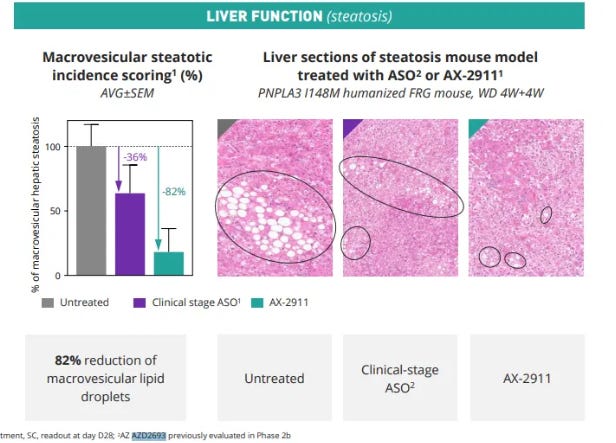
AX-2911 vs. AZD2693: correcting the protein outperforms deleting it, in the same disease model. AstraZeneca’s AZD2693 is the relevant comparator because it targets the identical biology: a liver-targeted antisense oligonucleotide designed to knock down PNPLA3 mRNA and protein in carriers of the I148M risk allele. In Phase 1, it worked as intended, it was well tolerated nd produced dose-dependent reduction in liver fat content in homozygous 148M carriers. But knockdown of total PNPLA3 output, mutant and any residual normal enzyme alike, was not sufficient to carry that biomarker signal to a clinical result: AstraZeneca discontinued the Phase 2b FORTUNA trial in November 2025 “due to efficacy.” In the identical PNPLA3 I148M humanized mouse model of steatosis, AX-2911 was benchmarked head-to-head against that same ASO and produced an 82% reduction in macrovesicular steatotic incidence versus AZD2693’s 36%, more than double the effect, read out on liver histology after subcutaneous dosing. The mechanistic distinction is the likely explanation: knockdown lowers the quantity of a still partially-dysfunctional protein, while editing corrects the transcript itself, so every molecule the edited cell produces functions closer to wild-type rather than a diluted dose of the same abnormal enzyme.
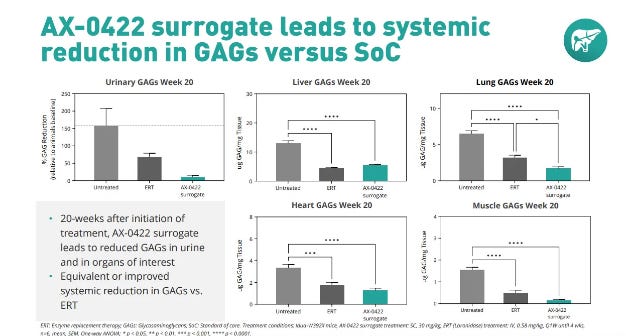
AX-0422 vs. ERT: endogenous source vs. weekly patch. Laronidase, the SOC enzyme replacement therapy for MPS I, has a well-documented ceiling: it requires lifelong weekly intravenous infusions lasting four to five hours, does not meaningfully cross the blood-brain barrier, provokes an antibody response in essentially all patients, and has a short circulating half-life between doses, meaning tissue ezyme levels swing between a post-infusing peak and a pre-infusion trough rather than holding steady. AX-0422 is designed to sidestep that architecture entirely: rather than supplying exogenous enzyme on a weekly schedule, it edits the patient’s own IDUA transcript so hepatocytes continuously produce and secrete functional enzyme for peripheral uptake, the same downstream biodistribution pathway ERT depends on, but fed by the body’s own cells instead of a recombinant infusion. In the Idua-W392X mouse model, twenty weeks after treatment initiation, the AX-0422 surrogate matched or exceeded ERT’s reduction in glycosaminoglycan accumulation across every compartment measured, urine, liver lung, heart, and muscle, despite ERT in this study being dosed weekly for four weeks by the labeled IV regimen. Urinary GAG reduction showed the widest separation, with the AX_0422 arm approaching baseline while ERT plateaued well above it.
One caveat. AZD2693’s failure was specifically a failure to translate a real biomarker ffect into the histological endpoints Phase 2b required, the same translation risk that applies to any preclinical steatosis result. Beating a discontinued knockdown drug in mice is non trivial, but it is also not a guarantee that correction clears the same bar AZD2693 missed.
More Data
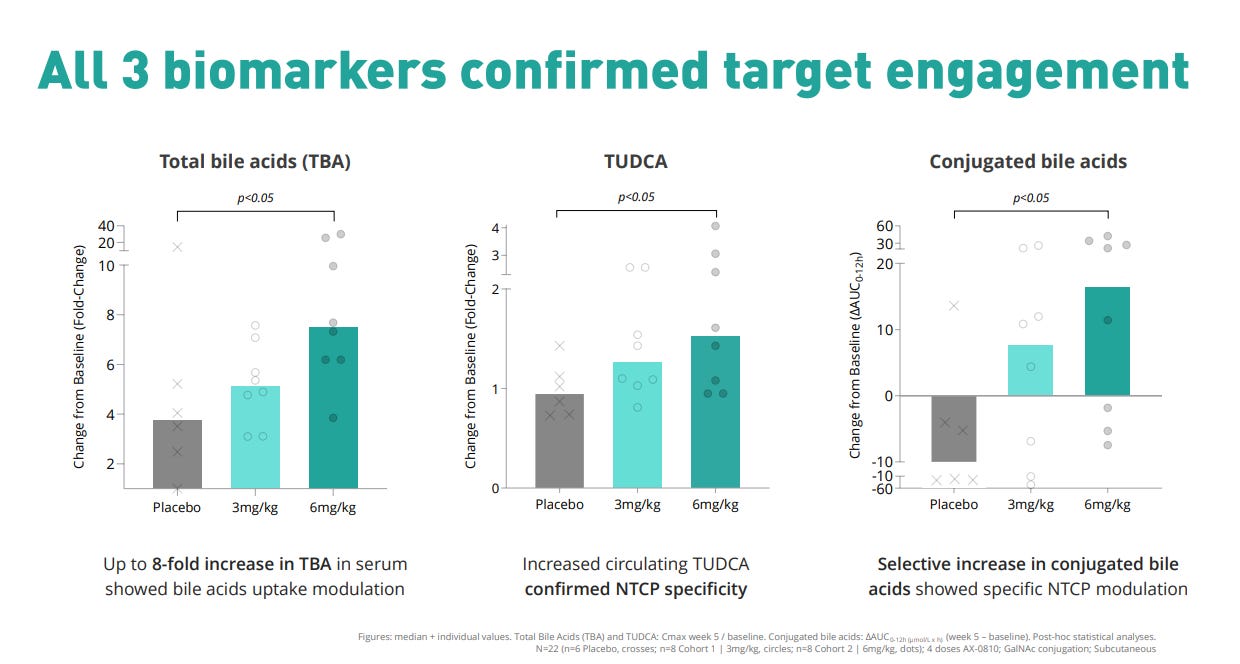
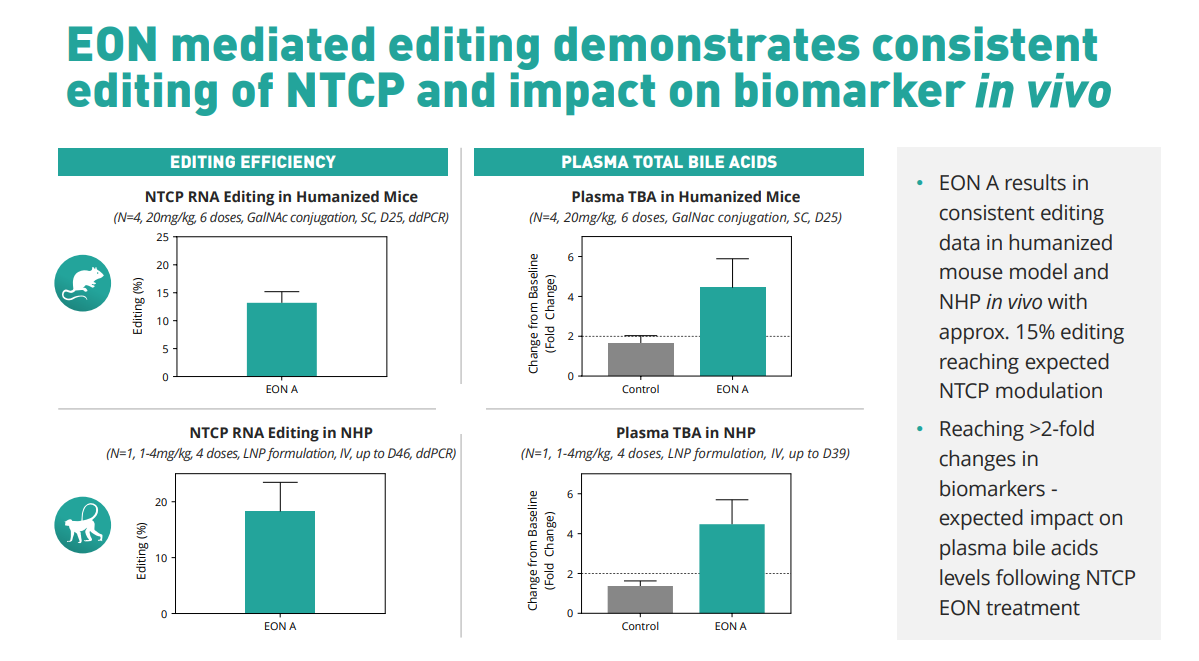
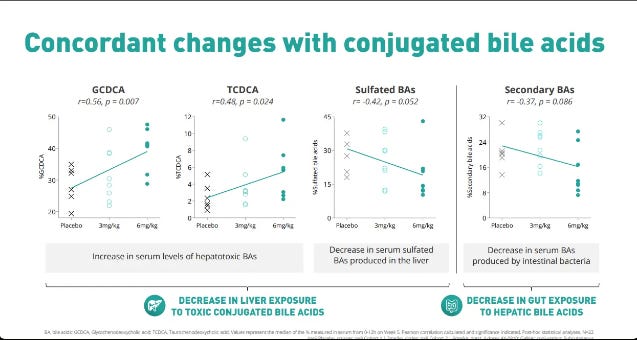
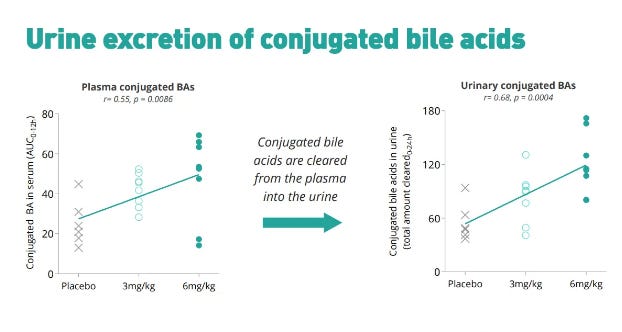
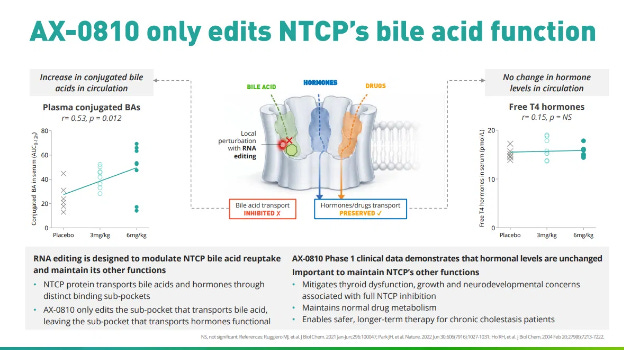
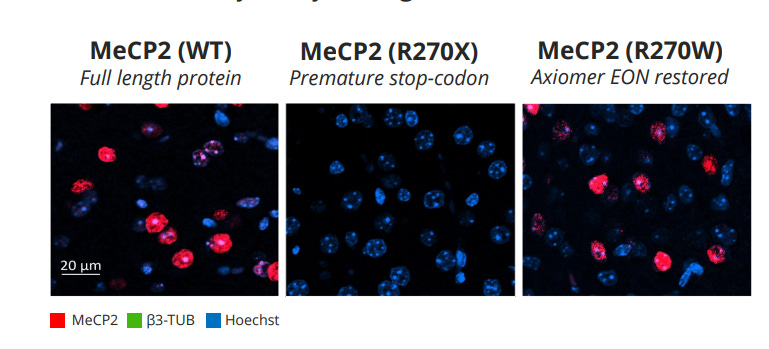
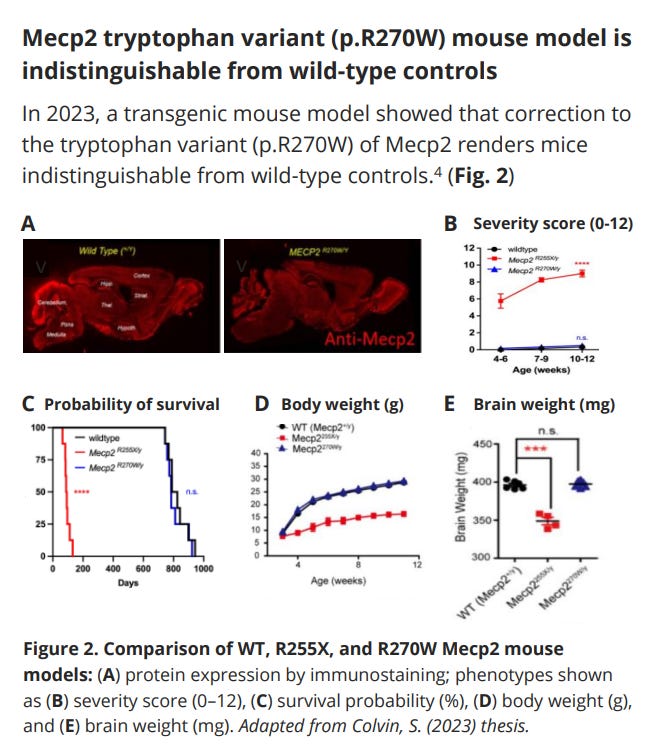
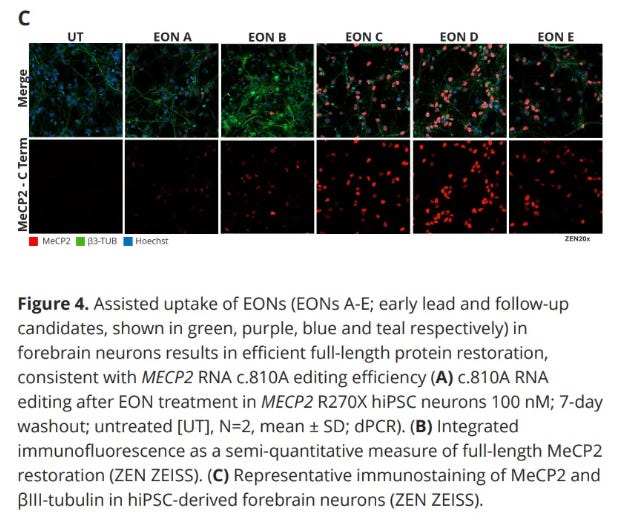
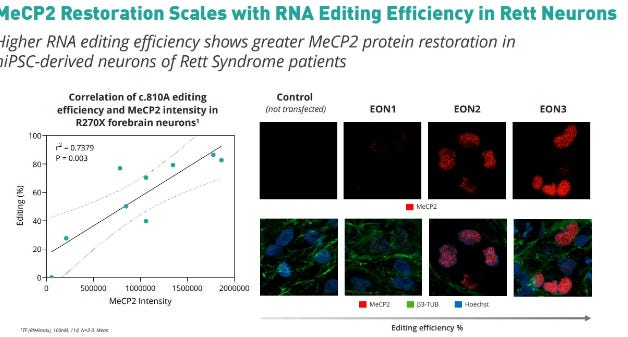
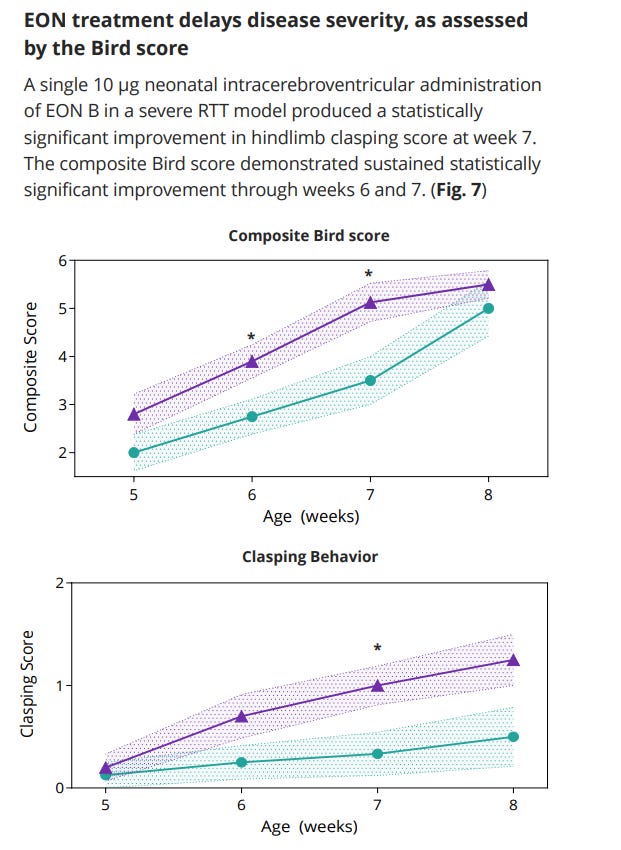
Taken individually, images 1-5 and 6-9 look like two separate data dumps. Taken as a set, each is built as a chain where every image exists specifically to close the objection the previous one opens, the full set, run on completely unrelated biology, land on the same underlying finding. In the NTCP cluster, Image 1 is a prediction (mouse and NHP), and Images 2-5 aren’t four separate proofs, they’re four cuts of one human dataset that pre-empt four separate skeptic questions in order: did it work at all (Image 2, three biomarkers triangulating), is the change biologically coherent rather than generic liver stress (Image 3, the hepatotoxic bile acid species moving as predicted), is it being handled safely rather than pooling dangerously (Image 4, the strongest correlation in the whole packet, renal clearance closing the loop), and is it a precise rather than a broad hit on the whole transporter (Image 5, hormone transport untouched). The Rett cluster runs the identical logic on a different organ: can editing restore protein at all (Image 6), is the specific protein it restores actually functional given it’s not a true wild-type sequence (Image 7, answered by independent academic mouse genetics, not ProQR’s own data, a deliberately non self serving source), can candidates be screened and improved in real disease-relevant cell types (image 8), and is the response quantifiable and controllable rather than binary (image 9).
The more important relationship is the one between the two subsets, not within them. Image9’s r²=0.74 relationship between precent editing and protein restoration in neurons is, mechanistically, the same finding as the dose-response that shows up later in human serum in Images 2-4: a small, partial edit produces a graded, predictable functional output. That exact pattern turning up independently in a membrane transporter in the liver and a nuclear transcription factor in the brain, in two different species combinations, is evidence about the platform’s editing technology itself, not just about either program. And Image 1 predicting Images 2-5 is the specific step, preclinical signal actually surviving contact with actual humans, that kills most programs before they ever get this far. Put together, the nine images cover two species beyond mice, two organ systems, two structurally unrelated protein classes, and both preclinical and clinical/in-vivo confirmation, all showing the same controllable, dose-dependent pattern. That’s a platform-level demonstration, and it’s the reason their collaboration with LLY is written for up to 10 targets rather than one.
The Market Cap
Shares outstanding are 159,708,468 full diluted. ~€16 million of debt. Net cash today is probably around $120 million. Against a $270M fully diluted market cap, implied enterprise value below $200 million for the whole Axiomer platform, all five Rett programs, MASH, cardiovascular, Hurler syndrome, and full exposure to a Lilly collaboration that can extend 10 targets.
In October 2024, when Wave Life Sciencesreported the first-ever human clinical proof of ADAR RNA editing, ProQR’s stock jumped over 100% in a single day, on someone else’s data, before ProQR had run a single human dose of its own. ProQR has since produced that exact category of proof in its own wholly-owned asset, and the stock hasn’t come close to repeating that move. The market has already shown, with real money, what it’s willing to pay for “ADAR editing works in a human”, it just hasn’t paid ProQR that price for doing it itself.
Comparisons
Wave Life Sciences: Same ADAR mechanism, first human proof, partnered with GSK for ~80% economics away. Value: ~1.38 billionMC, ~8x EV.
Neurogene: One program (NGN-401), Rett only, permanent AAV gene therapy, no big-pharma partner. ~$535 million MC, just raised ~$125M, ~3x EV.
Taysha Gene Therapeies: One program (TSHA-102), Rett only, AAV gene therapy, pivotal data pending H1 2027. Raised ~$200m in june offering, ~9x EV.
Ipsen/Albireo (2023 M&A): Only approved bile-acid modulator (PFIC) plus early pipeline, Alagille and BA both unproven. ~6x EV.
Every one of these trades or was bought for more than ProQR’s entire enterprise value, for a narrower, more concentrated bet. Neurogene and Taysha are single-program, permanent-dosing Rett plays with no equivalent of the Lilly relationship or a second, human-validated program sitting alongside it (WVE). Wave is the closest thing to an apple-to-apples read, same category of milestone, and gives away more economics on its lead asset than ProQR does on AX-0810. Albireo’s board explicitly priced part of the deal as a $10-per-share payment contingent specifically on Bylvay’s approval in biliary atresia. That particular bet expired worthless when BOLD failed in July. It doesn’t erase the fact that a large pharma company was willing to underwrite over $200 million for a shot at exactly this outcome, it just means that opportunity, structurally, now belongs to whoever’s left standing, which at the moment is a company with sub $200M EV. Bylvay itself, for reference, is now doing about $203M (€180 million) a year in sales off one approved cholestatic indication, a useful ceiling on commercial success in this exact disease category, even though AX-0810 is much earlier in that journey.
Not financial advice.