
Short and sweet.
Sol-Gel Technologies (SLGL).
NCT03703310 failed phase 3 in 2020. Company didn’t post trial results until 2024. Company begins new phase 3 trial in the same disease, with the same primary endpoint, in 2024. This second phase 3 design has less patients (n=140 *est vs n=174) than the first and thus worse powering, all else equal.
Gorlin Syndrome
Healthy people have two working copies of PTCH1, Gorlin patients have one. BCC requires two abnormal PTCH1s to develop. It is easy to understand why patients with Gorlin Syndrome develop hundreds of tumors starting in their early years. UV damage, etc. are far more dangerous for these patients because they only have one guard to protect them from tumors whereas everyone else has two.
SMO
Smoothened (SMO) is a protein that drives cell proliferation. PTCH1 inhibits it. As long as one PTCH1 is functioning, SMO remains in check. Once PTCH1 is non-functional, SMO runs rampant driving proliferation to unhealthy levels resulting in lesions. Thus, SMO became an obvious target for suppressing BCC. Vismodegib was the first FDA approved SMO inhibitor. It is a small molecule that binds directly to the transmembrane domain of SMO. Three years later, sonidegib was approved. It is also an SMO inhibitor. Because of its slightly different binding mode it has some activity against the SMO-D473H mutation, making it a popular second-line strategy after vismodegib, but cross-resistance still develops over time. What’s important to note is that both of these treatments are systemic, wheras patidegib, Sol-Gel’s lead candidate, is topically administered. Hence it’s phase 3 failing.
The Problem With Topical Administration
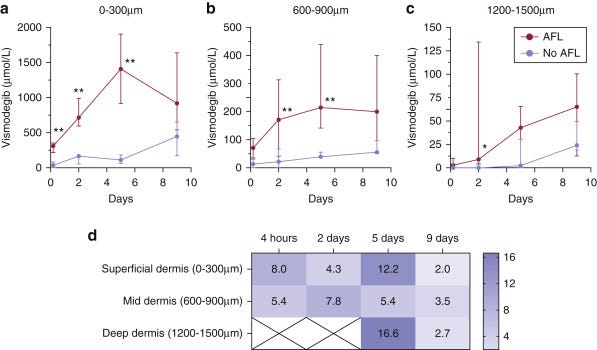
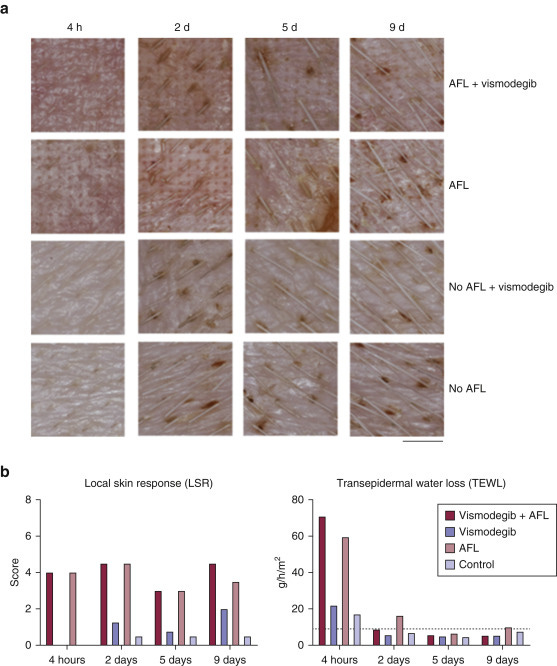
I’m going to keep this simple. For starters, vismodegib and patidegib are not meaningfully different from a topical-delivery perspective. Patidegib is:
~20% heavier than vismodegib: 505 vs 421 Da
more lipophilic: XlogP 4.6 vs 3.8
slightly less polar: TPSA 75.8 vs 84.5 Ų
Patidegib’s properties do not obviously predict easier deep-skin penetration, the extra ~84 Da works against diffusion somewhat. Their relative similarity makes the above experiment meaningfully relevant for the validity of the already failed topical patidegib hypothesis.
Stated succinctly because I am busy this week: a molecule with broadly comparable physicochemical properties to patidegib showed essentially zero deep-dermal exposure through intact skin, while physically bypassing the barrier produced deep-tissue concentrations comparable to or exceeding systemic exposure. Therefore, we need direct evidence that ordinary topical patidegib achieves adequate exposure in the relevant BCC-forming compartments. “The highest vismodegib concentrations reached 1,409.7 μmol/liter in superficial dermis and 62.3 μmol/liter in deep dermis, exceeding steady-state plasma concentrations previously reported for oral administration of vismodegib (5.5–56.0 μmol/liter). Ablative fractional laser increased vismodegib uptake up to 16.6-fold compared with intact skin.” Let’s do some quick math.
Low end: 8.7 / 0 > mathematically undefined/infinite
High end: 74.3 / 0 > likewise undefined
That’s why the paper appropriately describes the enhancement as an 8.2x increase in total mid/deep dermal delivery, rather than trying to express the individual deep-layer concentration ratio when the intact-skin measurement was zero. Understanding why abalative fractional laser treatment improves pk (and thus pd) is not important to our investigation of patidegib, what’s important is that we see a meaningfully similar molecule looking really terrible when administered topically without AFL vs its normal systemic administration, unless AFL is added into the mix. Active drug, but not dispersed broadly enough to all relevant compartments to work anywhere near as well as systemic. Same disease, same drug, same approach…
Readout expected November 2026.
Not financial advice.
I appreciate your work and opening up a new perspective, but I know this name very well and I believe a few things are worth adding to the context in your note. They made several changes to trial design in the new Phase 3 to improve powering and consistency between patients:
1) They're only enrolling high BCC burden patients (>10 facial BCCs) which dramatically increases the event rate (new BCCs) despite the smaller sample size. If the drug works, it's actually an improvement in powering. I don't want to rest my case on the post-hoc they ran with this subgroup because those are never reliable, but the case for these higher burden patients is very logical. The first trial enrolled patients with as few as 2 BCCs on their entire body, not just their face, and many didn't develop a single new tumor throughout the trial - you just can't power a preventative study that way.
2) The first p3 didn't genotype anybody, and only ~65% of patients had a confirmed PTCH1+ mutation, which you need to have for the drug to be effective. It's likely that 85% or so did have the mutation, but the rest have mutations that a PTCH1 inhibitor would be inert against. The new trial genotypes everyone and only allows PTCH1+, so there's no diluting the results with inherent non-responders.
3) Centralized dermatoscope evaluation might be a needle mover, it might not. They claim that the investigator's individual visual determination of new BCCs in the first p3 wasn't that accurate and they ended up misdiagnosing skin irritation or other artifacts as BCCs which never developed into one.
4) The trial was run during covid, had lots of missing data, and lots of dropouts. The trial showed a real delta (30% average reduction, 37% reduction in total BCCs across the trial), but the numbers were messy because of that missing data and the fact that they enrolled a heterogeneous patient population, including genetic non-responders, which the new trial fixes.
So, there's a real and legitimate trial enrichment effort here that I wouldn't count out. There's also apparently a big difference between these PTCH1 inhibitors in terms of skin:plasma ratio when applied topically, which is why this compound was chosen (there was likely also licensing considerations). They obviously worked on penetration enhancers to get the molecule deeper into the skin (hence why it causes some irritation), but they have data showing a pretty stark difference in skin retention.
It's worth watching this KOL event (linked below) they hosted with the head of the Gorlin Syndrome Alliance and the scientific founder of Pellepharm. They show more data on skin penetration vs other PTCH1 inhibitors, and actual human skin biopsy data showing deeper drug delivery (and changes in mRNA demonstrating pathway inhibition). It also goes in-depth on the p2 data, p3 design decisions and mistakes, and how they changed it.
https://lifescievents.com/event/sol-gel/
It might change your mind, it might not, but it did make the commercial opportunity very clear in my mind (ie, if it works this can actually be a $1B drug which skews the r/r heavily). Would be happy to chat about this further and exchange notes.
What has changed since the last trial cause they executed a pretty clean offering without warrant coverage and with good pricing earlier this year so doubt it is as 100% obvious of a 0 as you paint it.